Mother, Any Distance
Simon Armitage's 'Mother, Any Distance' perfectly captures the bittersweet tension of growing up. It's a poem that transforms a simple, everyday task—measuring a house—into a profound meditation on parental love, independence, and the terrifying thrill of stepping into the unknown.
Study Notes
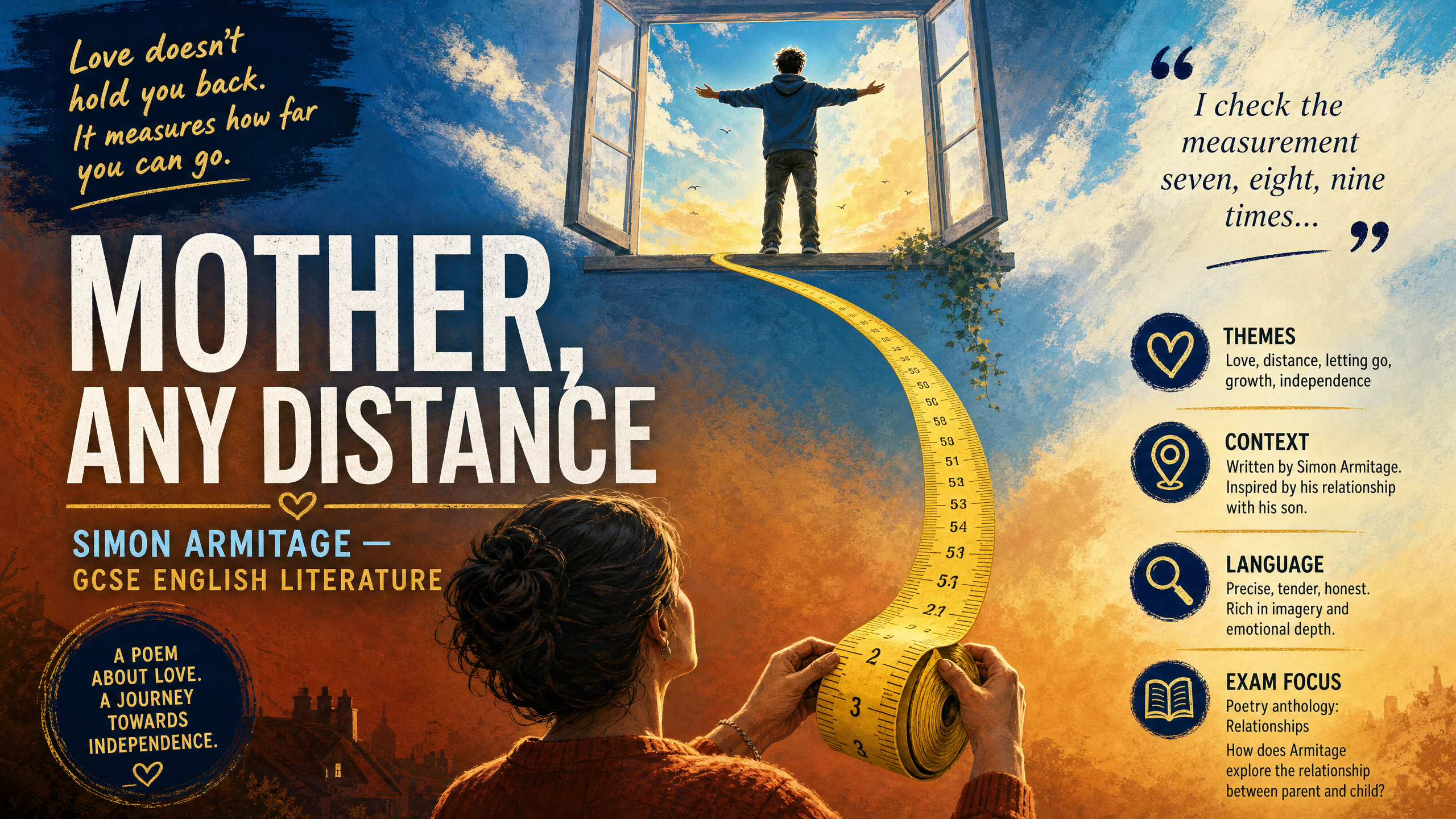
Overview
Simon Armitage's 'Mother, Any Distance' is a staple of the GCSE English Literature poetry anthology (often found in the 'Love and Relationships' cluster). It explores the complex, shifting dynamic between a mother and her adult son as he moves into a new home. The poem brilliantly balances the son's desire for independence with his lingering need for maternal security. Examiners highly reward candidates who can look beyond the literal act of measuring a house and analyse the poem's extended metaphors, specifically how Armitage uses physical distance to represent emotional separation. Strong responses will also engage with the poem's single-sentence structure and its loose sonnet form, exploring how these structural choices mirror the unbroken, yet evolving, bond between parent and child.
Plot/Content Overview
Stanza 1: The speaker requires his mother's help to measure his new house. She holds the 'zero-end' of the tape measure, grounding the process, while he begins to move away to measure the rooms.
Stanza 2: The speaker moves further away, 'reporting metres, centimetres back to base'. The physical distance between them grows, but the tape measure keeps them connected. The mother is described as an 'anchor' while he is a 'kite'.
Stanza 3: The speaker reaches the top of the house, walking 'space-walk' style across an empty bedroom. He reaches an attic hatch that opens to the sky. The tape measure has run out ('the line still feeding out, unreeling / years between us'). The poem ends with a moment of suspense as he faces the vast, open sky, realising he must now 'fall or fly' independently.
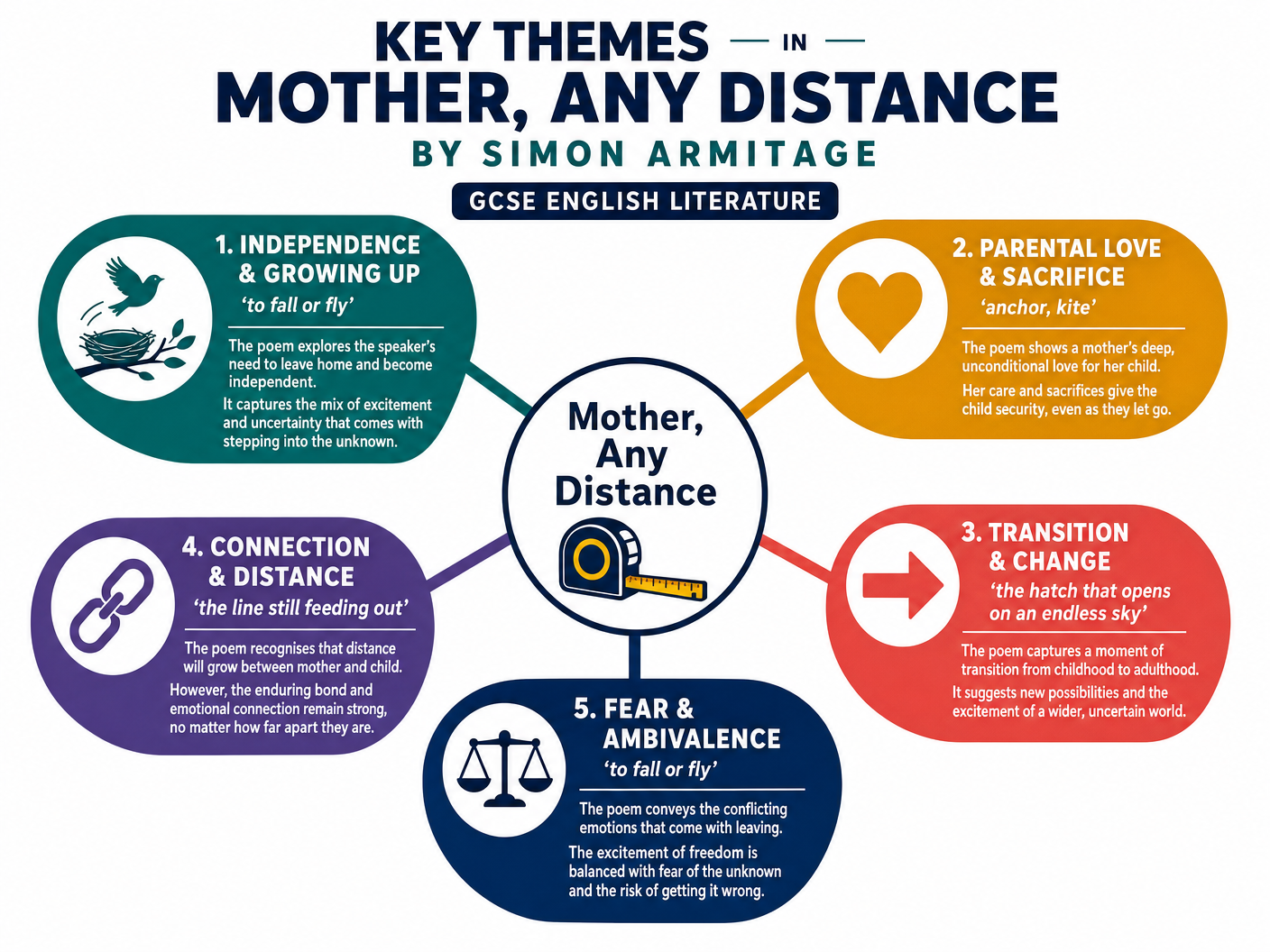
Themes
Theme 1: Independence and Growing Up
The poem fundamentally deals with the transition from childhood dependency to adult independence. The speaker's movement through the house mirrors his journey through life, moving further away from his mother's direct control. However, this independence is presented as both exciting and daunting.
Key Quotes:
- 'to fall or fly' (Stanza 3) - This final phrase perfectly encapsulates the risk of independence. There is no guarantee of success; the speaker must take a leap of faith.
- 'the hatch that opens on an endless sky' (Stanza 3) - The 'endless sky' symbolises limitless potential and freedom, but also the terrifying vastness of the unknown world without the safety net of home.
Theme 2: Parental Love and Security
Despite the focus on leaving, the poem strongly emphasises the enduring nature of parental love. The mother's presence is constant, providing the foundation from which the son can explore.
Key Quotes:
- 'You come to help me measure windows, pelmets, doors' (Stanza 1) - The mother's practical help is a manifestation of her care. She is actively involved in facilitating his transition.
- 'Anchor. Kite.' (Stanza 2) - This two-word sentence is a powerful metaphor. The mother is the 'anchor'—heavy, stable, and secure—allowing the son (the 'kite') to fly high and experience freedom without drifting away completely.
Theme 3: Connection vs. Distance
The poem explores the paradox that physical distance does not necessarily mean emotional disconnection. The bond between parent and child stretches but remains unbroken.
Key Quotes:
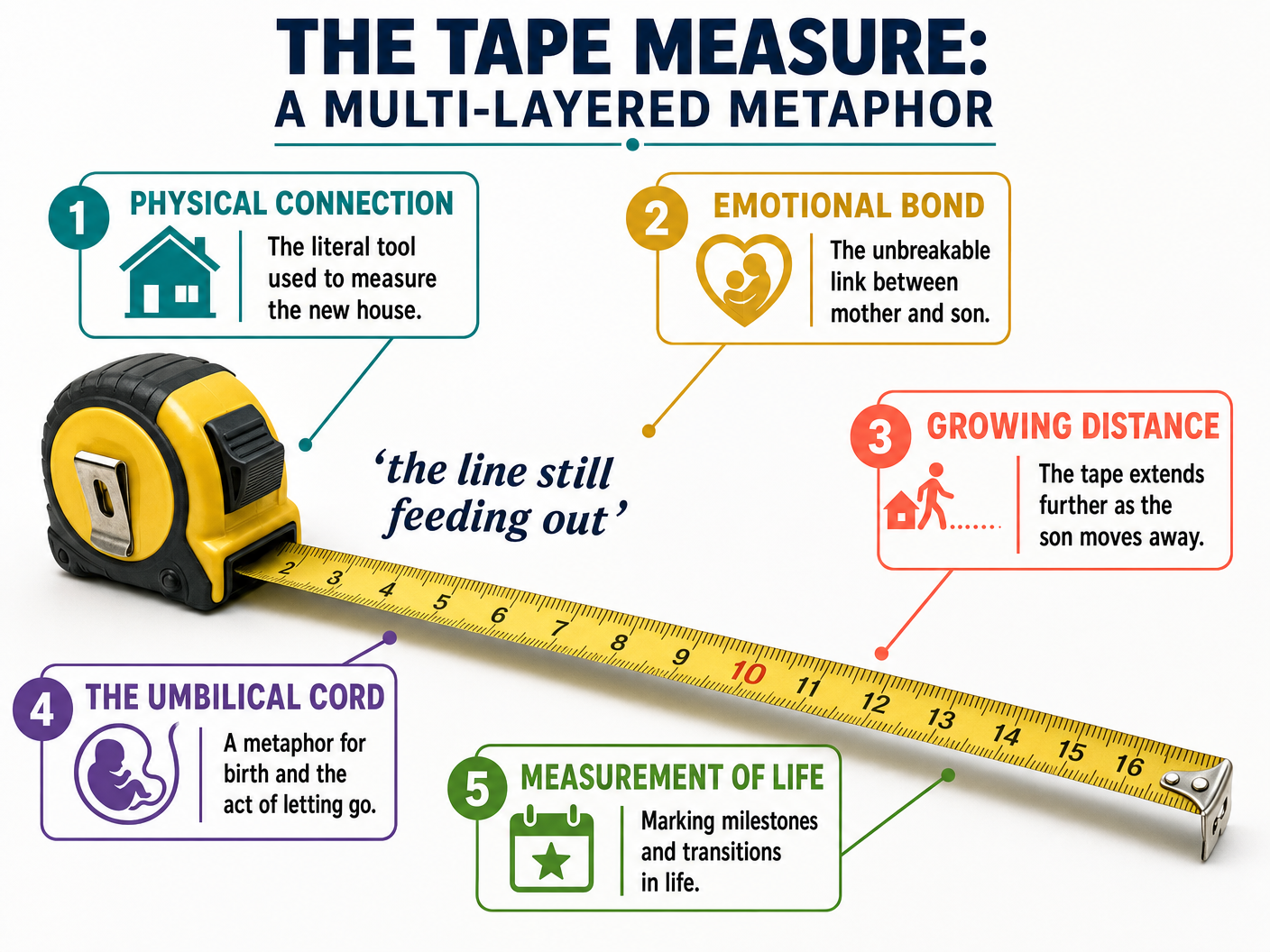
- 'the line still feeding out, unreeling / years between us' (Stanza 3) - The tape measure becomes a metaphor for time and memory. The connection remains ('feeding out'), even as the years and distance separate them.
- 'I space-walk through the empty bedrooms' (Stanza 3) - The verb 'space-walk' suggests extreme isolation and distance, as if the speaker is in a different atmosphere entirely, connected to his mother only by a thin lifeline (the tape measure/umbilical cord).
Character Analysis
The Speaker (The Son)
Role: The narrator, navigating the transition into adulthood and a new home.
Key Traits: Ambitious yet apprehensive, appreciative of his mother but eager for independence.
Character Arc: Moves from relying on his mother's physical help ('You come to help me') to standing alone at the threshold of independence ('to fall or fly').
Essential Quotes:
- 'I space-walk through the empty bedrooms'
- 'to fall or fly'
The Mother
Role: The supportive parent, facilitating her son's move while providing emotional grounding.
Key Traits: Supportive, steadfast, letting go reluctantly but necessarily.
Character Arc: She remains stationary ('at the zero-end') while her son moves, symbolising her role as a fixed point of reference in his changing life.
Essential Quotes:
- 'Mother, any distance greater than a single span / requires a second pair of hands.'
- 'Anchor.'
Writer's Methods
Extended Metaphor: The tape measure is the poem's central conceit. It represents the physical connection between them, the emotional bond, the passage of time ('unreeling years'), and ultimately, an umbilical cord that must eventually be cut or let go of.
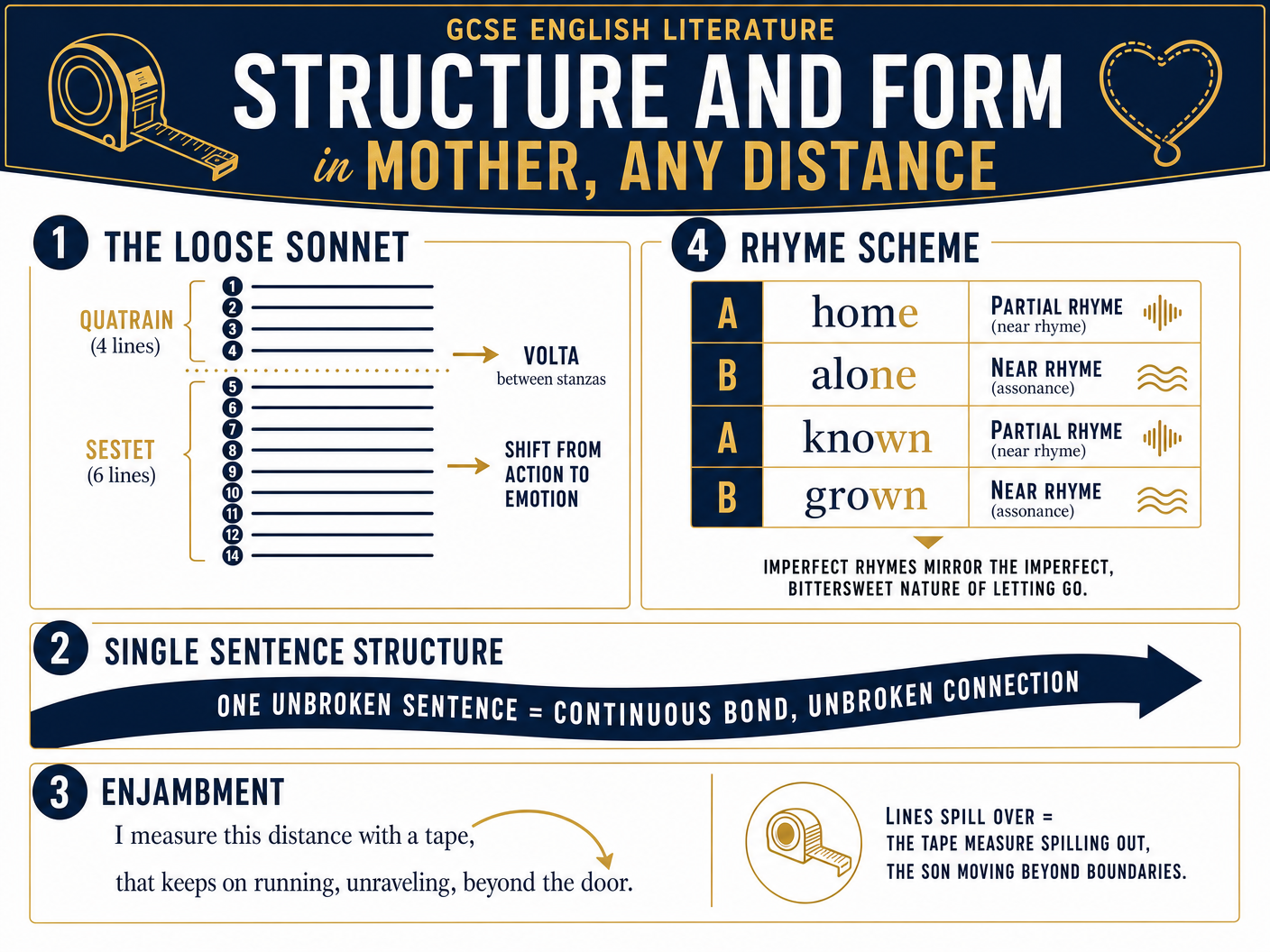
Structure - The Loose Sonnet: The poem has 14 lines (a quatrain followed by a sestet, though the stanza breaks vary in some editions). The sonnet form is traditionally used for romantic love, but Armitage adapts it to explore familial love. The irregular rhyme scheme (using half-rhymes like 'doors/floors' and 'span/hands') reflects the imperfect, sometimes awkward nature of this transition.
Structure - The Single Sentence: The entire poem is arguably one long, flowing sentence, heavily enjambed. This unbroken syntax physically mirrors the unbroken 'line' of the tape measure and the continuous emotional bond between mother and son.
Imagery of Measurement and Space: Armitage contrasts precise, domestic measurements ('metres, centimetres', 'windows, pelmets, doors') with vast, abstract imagery ('space-walk', 'endless sky'). This highlights the shift from the known, safe domestic sphere to the vast, intimidating wider world.
Context
Simon Armitage is a contemporary British poet (and the current UK Poet Laureate). 'Mother, Any Distance' was published in his 1993 collection Book of Matches. The poems in this collection were designed to be read in the time it takes a match to burn down—suggesting a brief, intense flare of emotion or memory. The poem reflects universal themes of leaving home and the changing dynamics of family relationships in late 20th-century Britain, where young adults often move significant distances away from their parents for work or study. Examiners expect candidates to use this context to inform their analysis of the universal emotional experience of growing up, rather than treating it as historical trivia.
Listen to our comprehensive podcast summary here:
Visual Resources
3 diagrams and illustrations
Interactive Diagrams
1 interactive diagram to visualise key concepts
Conceptual Flow Outline
The narrative and emotional progression in Mother, Any Distance
Worked Examples
1 detailed example with solutions and examiner commentary
Practice Questions
Test your understanding — click to reveal model answers
Compare how poets present the experience of growing up in 'Mother, Any Distance' and one other poem from the 'Love and Relationships' cluster.
Hint: Consider 'Walking Away' (for a parent's perspective on growing up) or 'Follower' (for a child's changing perspective of a parent over time).
How does Armitage use structure and form to convey meaning in 'Mother, Any Distance'?
Hint: Look beyond the words. Think about the sonnet form, the sentence length, the enjambment, and the rhyme scheme.
Explore the significance of the final line: 'to fall or fly'.
Hint: Consider the contrast between the two verbs and why Armitage leaves the ending unresolved.
Compare the presentation of memory and the past in 'Mother, Any Distance' and 'Before You Were Mine'.
Hint: Focus on how the tape measure represents time in Armitage, and how Duffy uses sensory imagery to access the past.